


Jeb’s Horizon EFB
An electronic flight bag for iOS, Android and Mac with DeepVision synthetic vision: moving map, approach charts, weather, flight planning and live traffic.
John (Wonmo) Seong
Founder | Engineer | Pilot in training
Los Angeles metro area


Apple WWDC23 Swift Student Challenge winner
Invited to Apple Park, Cupertino
US O-1A visa | UK Global Talent visa
He started by drawing what nobody can see: electron clouds, orbitals and density maps, so that a student could look at quantum mechanics instead of just reading about it. One of those density maps ended up on the cover of a Nobel laureate’s biography. Today he builds computers that ride in the cockpit and look out of the window.
Now | since September 2025
John founded Orchestr Aerospace in September 2025 and runs it as CEO and technical founder. The company builds dual-use avionics, for civilian and defence aviation, from offices in Irvine, California, and Montréal.
“An AI computer that works in the cockpit.”
The thread from his physics work is direct. A density map is a computer showing a person what it knows about a scene they cannot see. A cockpit computer does the same with traffic, terrain and weather. Orchestr’s research goes one step further: working out where the aircraft is from what its cameras see, so navigation keeps working when GPS is jammed or spoofed.
An electronic flight bag for iOS, Android and Mac with DeepVision synthetic vision: moving map, approach charts, weather, flight planning and live traffic.

The same flight bag on 3D terrain, running in the browser with no install.

A copilot you can talk to, trained on your own aircraft’s handbook. It answers from the documents it was given; the pilot in command stays responsible.
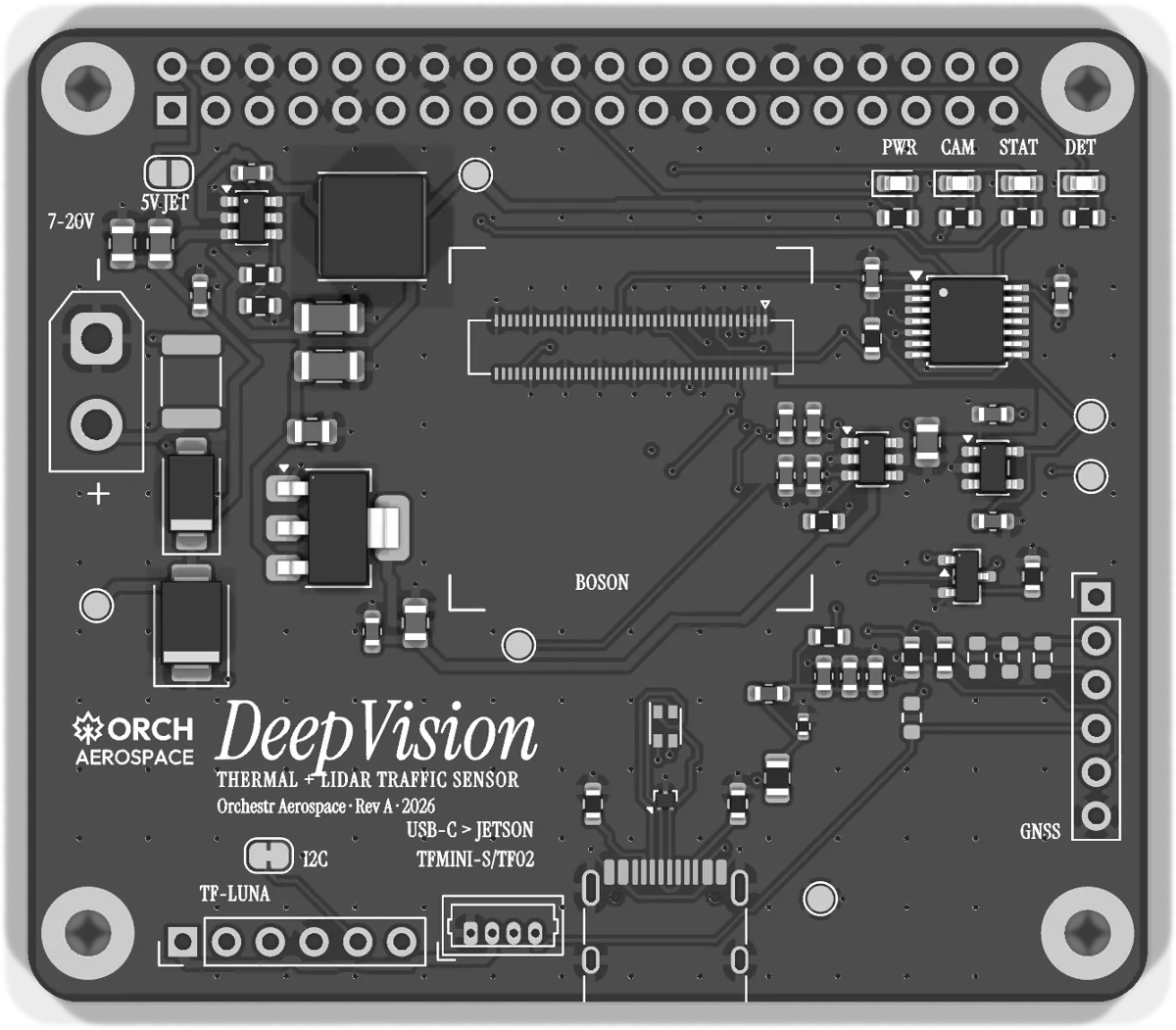
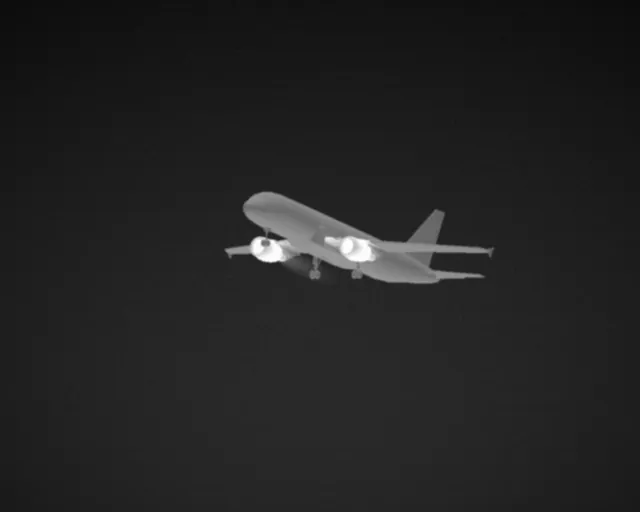
Thermal traffic and obstacle awareness: spots other aircraft and obstacles day or night, with laser ranging.
CA$6,999 est. retail | Estimated Q3–Q4 2027
The artificial horizon, terrain map and on-device POH copilot in one handheld unit: an NVIDIA Jetson Orin Nano with a stereo camera pair and software-defined radio.
CA$1,299 est. retail | Estimated Q2 2027
…like artificial intelligence, but the
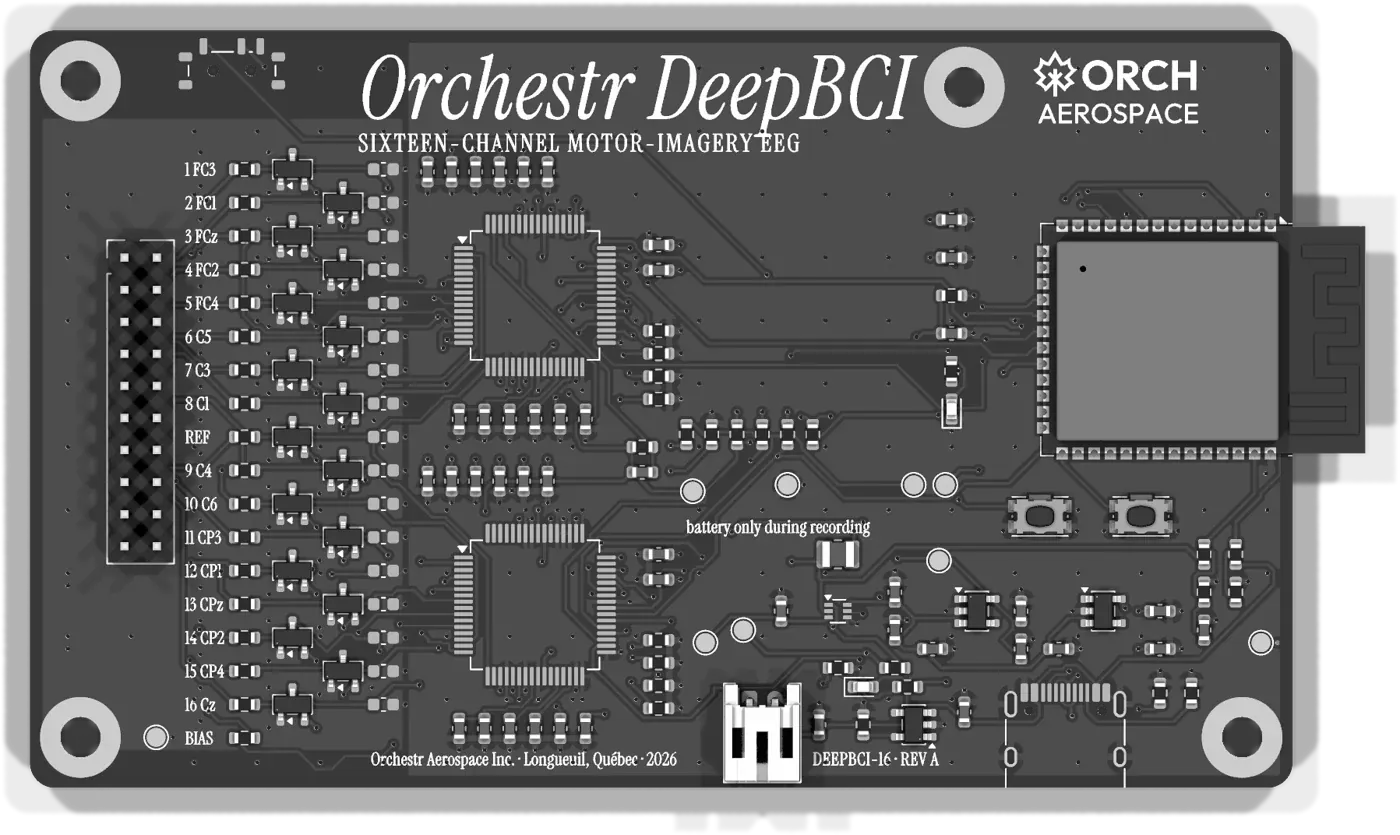
▶ FULL VIDEOA 16-channel EEG board that reads the pilot’s intent and moves the FMS cursor, hands on the controls.
CA$649 est. retail | Estimated Q2 2027
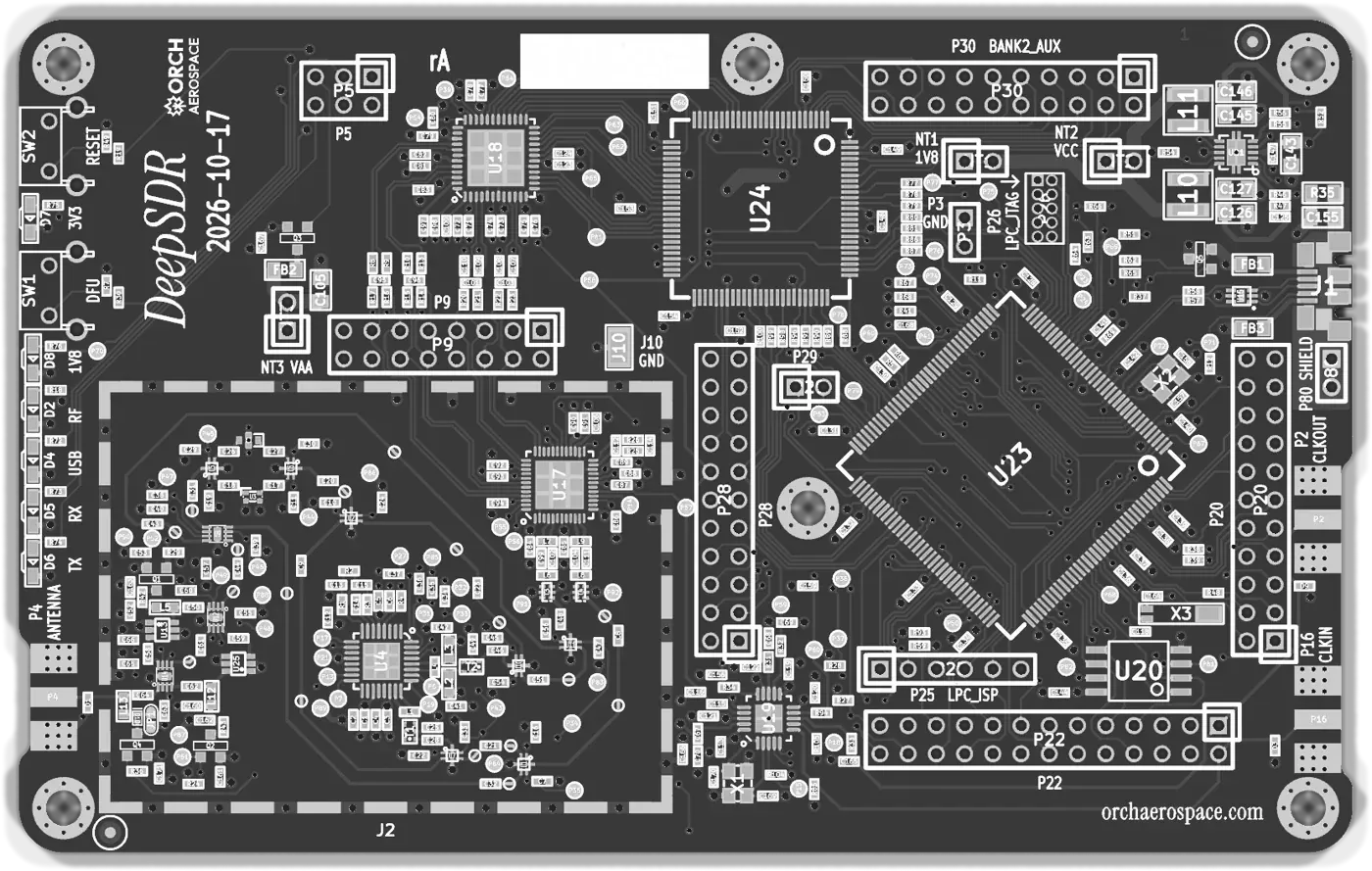
Wideband software-defined radio, 1 MHz to 6 GHz, receive and transmit.
CA$499 est. retail | Estimated Q2 2027

The company aircraft, flown as a sensor platform and a testbed for ADS-B and computer-vision traffic detection.
The long-term plan is autonomous flight in general aviation, and eventually a high-altitude spaceplane that flies above the Kármán line.
The story so far
One line, six stations. Each stop taught him something the next one needed.
2022
In 2022 he entered the Breakthrough Junior Challenge with “Schrödinger’s Equation & DFT in 90 Seconds”, a 90-second explainer of the Schrödinger equation and density functional theory. The same year he started ElectronVisualized, a web app that runs real DFT calculations and draws the resulting electron density and molecular orbitals in 3D. It later grew iOS, macOS and visionOS versions.
Loading the 3D model
June 2023
His Swift Student Challenge app playground turned the Heisenberg uncertainty principle into something you could play with, and it won. MobileSyrup named him one of six Canadian winners. Apple invited him to Apple Park for WWDC23, where he met engineers from the Vision Pro team, iJustine and MKBHD, then wrote it all up on Medium and YouTube. The playground grew into Atomizer AR, an augmented-reality atom and orbital viewer.


Seoul
A summer research internship at Seoul National University turned side projects into tools. He built electronvisual.org, brought Atomizer AR up to industry standard, and developed LCBC Dock, now MolDock, which pulls fragmented protein–ligand docking tools into one app on the App Store and Google Play. His DFT density map of the hydrogen molecule went on to become the cover art of Sir David Clary’s biography of Walter Kohn.
2024
The questions moved from atoms to people. OpticALLY 3D Scan builds a 3D model of a head from nothing but an iPhone’s TrueDepth camera. He wired an OpenBCI brain–computer interface into a flight simulator and flew with it; the clip drew 156 reactions on LinkedIn. Around the same time he started flight training.
2025
From August to December 2025 he worked as a software engineer at Reach, building a TrueDepth face-scanning app with the company’s CEO, Drew Shepard. In September he founded Orchestr Aerospace. By December he was at UCLA, telling the Global Entrepreneurship Society why he wants to replace the autopilot with vision-based AI.

2026
Orchestr’s apps reached the App Store and Google Play, the company aircraft Piper Astrid started carrying cameras, and the team reported from Kennedy Space Center for the Artemis II launch. In October 2026 Orchestr introduced Jeb’s AI to its pilot audience.
Next
Autonomous flight in general aviation, then above the Kármán line.
Collaboration | Sir David Clary FRS
John collaborated with the Oxford chemist Sir David Clary FRS on his biography of Walter Kohn, the physicist behind density functional theory.

Walter Kohn: From Kindertransport and Internment to DFT and the Nobel Prize
David C. Clary | World Scientific | 2024
The front cover is built on an electron density map of the hydrogen molecule that John calculated with density functional theory, the theory Kohn created. The book’s preface credits it:

Preface, World Scientific
Walter Kohn left Vienna as a boy on the Kindertransport, was interned as an “enemy alien” in Britain and Canada, and went on to develop density functional theory, the method that lets chemists compute the electronic structure of molecules and materials. It earned him the 1998 Nobel Prize in Chemistry, shared with John Pople. Clary’s book follows that whole arc, from refugee to laureate.
Sir David Clary FRS is a theoretical chemist and Professor of Chemistry at the University of Oxford. He was President of Magdalen College, Oxford, from 2005 to 2020, and the first Chief Scientific Adviser to the UK Foreign and Commonwealth Office, from 2009 to 2013.
Activity
Orchestr’s company posts and John’s own, newest first. Each one opens right here, or on LinkedIn.
New today

“At Orchestr, we find novel ways to make general aviation flying safer and even more fun.”
Orchestr presents Jeb’s AI to its pilot audience. Jeb’s AI is a copilot you talk to, trained on your aircraft’s own handbook, and you can try it now at orchaero.com.
Loading posts from LinkedIn lets LinkedIn set its own cookies. Your choice is remembered on this device.
From Orchestr Aerospace

“Meet Flight Computer 1, a vision-based approach to flight radars for general aviation and beyond.”
Flight Computer 1: traffic, weather and terrain detection by camera, as a low-cost alternative to TCAS that does not depend on ADS-B.

“Making Autonomous Flying Possible in GA and beyond.”
The autonomous flying stack in the cockpit, and the longer goal: a high-altitude spaceplane that reaches above the Kármán line, 100 km up.
“Say Hello to our company aircraft, Piper Astrid.”
Nine photos of the company aircraft, the testbed for sensor readings behind Orch Avionic 1 and 2 and their ADS-B and computer-vision traffic alerts.

“Check out Jeb’s 3D Flight Bag, new state of the art EFB (Electronic Flight Bag) app”
Jeb’s 3D Flight Bag arrives on the App Store and Google Play, for general aviation and commercial pilots.

“Modernising General Aviation. Orch Avionic 1 team’s Jebediah Flight Bag app.”
A video of the Jebediah Flight Bag app built by the Orch Avionic 1 team, running weather radar on a tablet.

“Artemis II Launch Reaction, reporting from Kennedy Space Center”
John at Kennedy Space Center for the Artemis II launch, reporting for Orchestr.
From John

“Scan 3D only using an iPhone”
OpticALLY 3D Scan in action: a full 3D head model from an iPhone’s TrueDepth camera.

“Introducing Flight Simulator + Brain Computer Interface”
A flight simulator controlled through a brain–computer interface, built on the open-source OpenBCI platform.

“Introducing Atomizer AR. Your Swiss Army Knife in Chemistry.”
The App Store launch of Atomizer AR, including sketch-to-IUPAC name conversion.

“Bioinformatics Demo – ElectronVisualized”
A bioinformatics demo of ElectronVisualized, from atomic orbitals to protein–ligand docking.

“Previously unreleased promo video for Electronify, an atomic and molecular orbital viewer”
A promo for Electronify, the orbital viewer he also submitted to the Swift Student Challenge.

“I might have to make a question list when I’m interviewing Apple’s top engineers”
The countdown to WWDC23, and a question list for Apple’s engineers.
Press and recognition
Coverage of the WWDC23 win, his own write-ups from Cupertino, and the videos that explain the work.

 June 5, 2023
Profiles John among Canada’s six winners. His app playground showed the Heisenberg uncertainty principle through electrons in a cloud around the nucleus.
mobilesyrup.com
His first-person account of WWDC23 at Apple Park: meeting iJustine and MKBHD, and questioning Apple engineers about the newly announced Vision Pro.
medium.comProjects
Science tools, computer vision, a brain–computer interface, two social apps and a short film.
Loading the 3D model
2022 – 2025 | Web | iOS | macOS | visionOS | DFT
A 3D atomic and molecular orbital visualizer. ElectronVisualized computes electron density with density functional theory and renders it in the browser; Atomizer AR, his WWDC23 Swift Student Challenge project, puts atoms and orbitals in augmented reality on iPhone and Vision Pro.
2024 – 2025 | iOS | TrueDepth | C++
“Scan 3D only using an iPhone.” A Swift and C++ app that turns the TrueDepth camera’s point clouds into a measured 3D head model: pose estimation, ICP registration and meshing, exported as OBJ. US patent pending (63/727,879).

2024 | OpenBCI | EEG | Flight sim
A flight simulator flown through an OpenBCI brain–computer interface. Orchestr’s DeepBCI takes the same idea into the cockpit: a neural band that drives the cockpit display’s cursor without the pilot’s hand leaving the controls.
iOS | Android | AutoDock Vina
Protein–ligand docking is spread across many separate tools. MolDock brings them into a single mobile app, on the App Store and Google Play.

Social video | Habits
A habit tracker that works like a social video app: you keep a habit by posting it.
AR | VR | Short video
A short-video platform for AR and VR headsets, built with William Zhang and Bryan Zhao. John joined as co-founder in June 2023.

2021 – 2022 | Short film | VFX | Original score
A short film with a visual-effects black hole and an original score, both his own.
Electronify, an electron orbital explorer. Orch-OR Visualizer, an interactive model of the Penrose–Hameroff theory of consciousness. Orch A320 Guide for Apple Vision Pro. 1st Principle Graph Calculator. BlackHole, a real-time relativistic ray marcher.
Talks
Global Entrepreneurship Society at UCLA | December 2025
John spoke to UCLA’s Global Entrepreneurship Society about building Orchestr. The talk covered four ideas.
01
Letting a pilot work the cockpit displays without taking a hand off the controls.
02
Aircraft that understand the scene outside, not only the numbers from their instruments.
03
Ship in public, post the demos, and let the work make the case.
04
“I hate competition; I want to dominate.”

“the Global Entrepreneurship Society at UCLA had the pleasure of hosting John Seong”
GES at UCLA on hosting John: BCI for next-generation avionics, and replacing the autopilot with vision-based AI.
Loading posts from LinkedIn lets LinkedIn set its own cookies. Your choice is remembered on this device.
Recommendation
“John exhibits great excellent communication skills, and works with the team to achieve desired goal. John is proactive in all that he does, and makes sure that and obstacles that can be foreseen, are avoided.”Contact
For Orchestr, pilots, investors or press, LinkedIn and email both reach him.


